EU Short-Term Rental Rules in 2026: What Vacation Rental Owners Need to Know
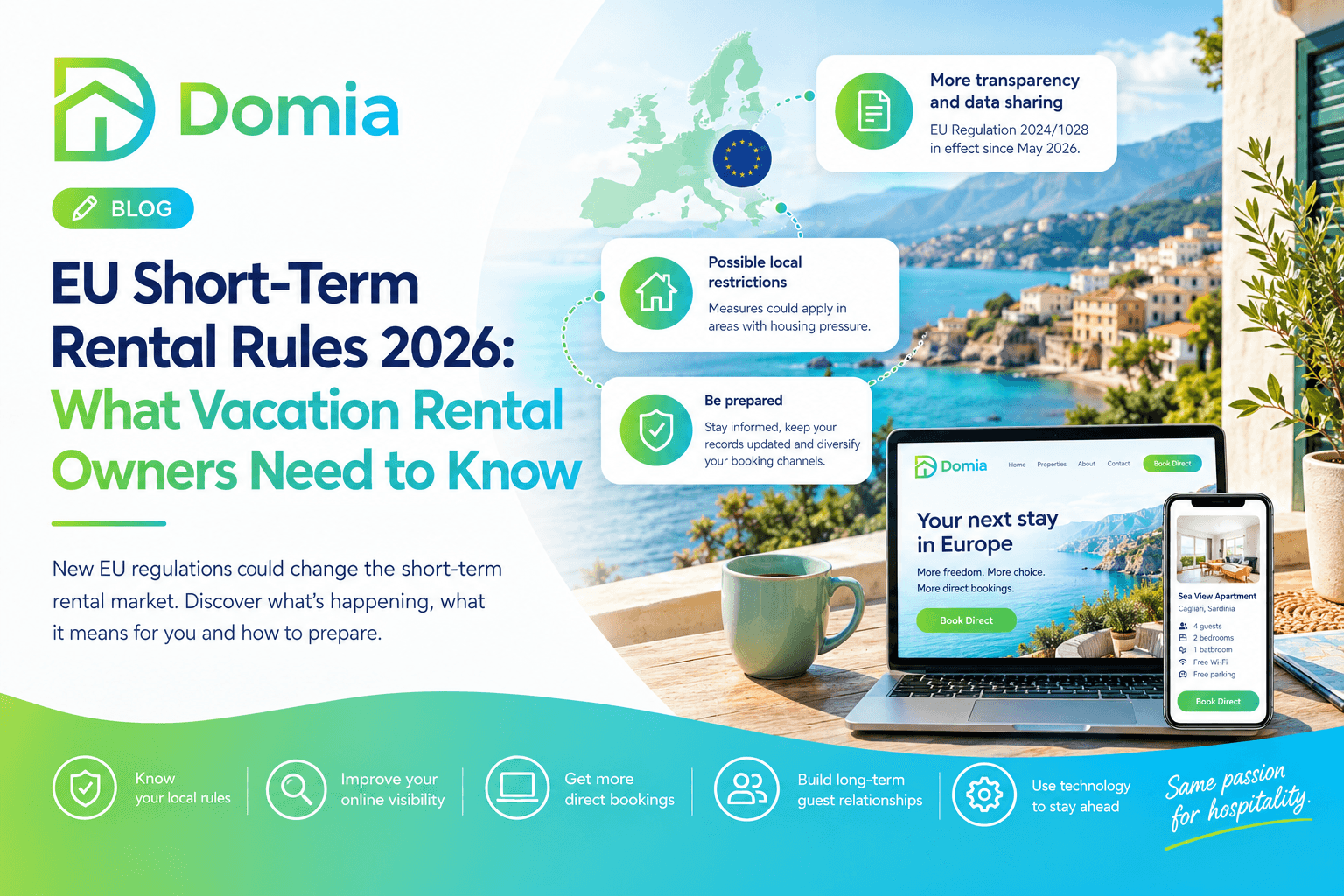
EU Short-Term Rental Rules in 2026: What Vacation Rental Owners Need to Know
The European short-term rental market is entering a new regulatory phase.
For years, platforms such as Airbnb and Booking.com have transformed tourism across Europe, creating new opportunities for property owners while also raising concerns about housing affordability in some cities and tourist destinations.
Now, the European Union is taking a more active role.
In 2026, a new EU framework for short-term rental data sharing has started to apply, while the European Commission is also preparing further legislation that could allow authorities to introduce additional measures in areas experiencing significant housing pressure.
For vacation rental owners, the message is simple:
The short-term rental market is becoming more regulated, and professional property management is becoming increasingly important.
But what exactly is changing?
The EU Is Not Banning Short-Term Rentals
First, let's clear up one important misconception.
The EU is not introducing a blanket ban on Airbnb or vacation rentals across Europe.
The European Commission's proposed approach is focused particularly on areas experiencing housing stress.
According to the Commission, the planned Affordable Housing Act would give Member States, regions and local authorities tools to address housing affordability according to local conditions. Short-term rentals are expected to be an important component of this framework.
Reuters reported on 4 September 2026 that the draft proposal could allow authorities to introduce measures such as quantitative limits or protections for existing operators in areas identified as experiencing housing stress. However, the proposal still needs to go through the EU legislative process before becoming law.
This means hosts should prepare, but shouldn't panic.
What Has Already Changed in 2026?
A separate EU regulation is already in force.
Regulation (EU) 2024/1028 establishes a European framework for collecting and sharing data related to short-term accommodation rental services. It has applied since 20 May 2026.
The objective is to create greater transparency around short-term rentals and help public authorities understand what is happening in their local accommodation markets.
Among other things, the framework provides for registration systems and data sharing between digital platforms and public authorities.
For hosts, this reinforces an important trend:
Accurate registration, documentation and property information are becoming increasingly important.
Why Is the EU Looking at Short-Term Rentals?
The issue is particularly important in Europe's most popular tourist destinations.
Cities and regions across Europe have been dealing with concerns about:
- Housing affordability
- Limited long-term rental supply
- Growth in tourist accommodation
- Pressure on local communities
- Increasing tourism demand
- Housing availability for residents
The European Commission has specifically highlighted the housing pressures experienced by major cities and popular tourist destinations.
However, the situation varies enormously from one location to another.
A small rural destination with many family-run holiday rentals does not necessarily face the same challenges as a major city experiencing severe housing shortages.
This is why the Commission has emphasized that measures should take local circumstances into account.
What Could Change for Vacation Rental Owners?
If the proposed Affordable Housing Act becomes law, the biggest impact may not be a single Europe-wide rule.
Instead, hosts could face different rules depending on where their property is located.
Possible measures discussed in the current policy debate include:
Registration requirements
Hosts may need to ensure that their property is correctly registered with the relevant authority.
Local restrictions
Authorities in areas experiencing housing stress could potentially introduce restrictions on short-term rental activity.
Limits on the number of properties
Some locations could potentially consider quantitative limits or similar measures if permitted under the final framework.
Greater transparency
Authorities are likely to have access to more data about short-term rental activity.
Stronger enforcement
As data becomes more standardized, it may become easier for authorities to identify properties operating outside local requirements.
However, these possible measures should not be interpreted as rules already applying throughout the EU.
The final legislation and national and local implementation will determine what actually applies in each market.
What Should Vacation Rental Owners Do Now?
The best response isn't to stop operating.
It's to become more professional and more independent.
Here are five steps hosts can take now.
1. Know the Rules in Your Local Market
EU legislation is only part of the picture.
Vacation rental owners may also have to comply with:
- National tourism regulations
- Regional legislation
- Municipal rules
- Registration requirements
- Tax obligations
- Building regulations
- Safety requirements
The exact rules depend on where your property is located.
Before making changes to your business, always check the relevant official national or local authority.
For EU-level developments, the European Commission's Affordable Housing Act information is a useful starting point.
2. Keep Your Property Information Accurate
As governments receive more information about short-term rentals, accurate property data becomes increasingly important.
Make sure you maintain accurate records of:
- Property address
- Registration details
- Host information
- Accommodation capacity
- Availability
- Booking information
- Guest information where legally required
- Tax documentation
Digital tools can help hosts keep their operations organized and reduce administrative mistakes.
3. Don't Depend Entirely on OTAs
There is another important lesson emerging from the changing regulatory environment.
Your business should not depend entirely on a single booking platform.
Airbnb and Booking.com remain powerful distribution channels, but relying exclusively on them means that your business is highly dependent on third-party platforms.
A strong direct booking strategy gives you another channel.
Your own website allows you to build:
Your brand → Your audience → Your guest relationship → Your direct bookings
Domia has already explored this strategy in:
👉 How to Reduce OTA Commissions Without Losing Bookings in 2026
And for a broader strategy:
👉 The Ultimate Guide to Reducing OTA Dependence and Increasing Direct Bookings in 2026
4. Build a Strong Direct Booking Website
A professional website is becoming more than a marketing tool.
It can become the central digital hub for your business.
Your website should clearly communicate:
- Who you are
- Where your property is located
- What you offer
- Your prices
- Availability
- Cancellation policies
- Reviews
- Contact information
- Booking options
It should also make it easy for returning guests to book directly.
Domia's guide explains how to create a website designed specifically to turn visitors into direct bookings:
👉 How to Build a Vacation Rental Website That Converts Visitors Into Direct Bookings
Domia recently explored this strategy in:
👉 How to Turn First-Time Guests Into Repeat Customers
A strong repeat-guest strategy can reduce your dependence on both paid advertising and OTA commissions.
Technology Can Help Hosts Adapt
Regulation isn't the only change happening in the vacation rental industry.
Technology is changing the way properties are marketed, managed and communicated with guests.
AI-powered tools can help hosts automate repetitive communication, answer common questions and provide information to guests around the clock.
Domia's article on AI Concierge explains how this technology can support the modern guest journey:
👉 Why Every Vacation Rental Needs an AI Concierge in 2026
The objective isn't to replace hospitality.
It's to allow independent hosts to operate more efficiently while maintaining a high level of service.
What This Means for Hosts in Sardinia and Other Tourist Destinations
For destinations such as Sardinia, Sicily, the Balearic Islands, Greece, Croatia and other Mediterranean markets, the regulatory discussion deserves particular attention.
These regions can experience significant seasonal tourism demand while also dealing with local housing challenges.
The European Commission has explicitly recognized that housing pressure varies between different cities, regions and tourist destinations.
For this reason, hosts should avoid assuming that a regulation introduced in Barcelona, Paris or another major destination will automatically apply in the same way to their own property.
Local legislation matters.
The best strategy is to monitor national and regional developments while making the business itself more professional and diversified.
The Future of Short-Term Rentals in Europe
The European short-term rental industry is unlikely to disappear.
But it is changing.
The direction of travel appears to be toward:
More transparency
More data
More professional operators
More local regulation
Greater focus on housing affordability
More sophisticated digital tools
For professional hosts, this can actually create opportunities.
Businesses that keep accurate records, follow local requirements, provide excellent guest experiences and develop their own direct booking channels may be better positioned for a more regulated market.
What Vacation Rental Owners Should Do in 2026
If you manage a vacation rental in Europe, consider this your checklist:
✅ Check your local registration requirements ✅ Understand your national and regional regulations ✅ Keep property and booking information accurate ✅ Monitor upcoming EU and local legislation ✅ Build your own direct booking website ✅ Invest in SEO and Google visibility ✅ Build relationships with previous guests ✅ Reduce dependence on a single OTA ✅ Use technology to simplify guest communication ✅ Focus on professional, compliant operations Final Thoughts
The EU's approach to short-term rentals is evolving.
The EU Regulation on short-term accommodation data sharing is already applicable, while a separate Affordable Housing Act is being developed that could give authorities additional tools to address short-term rentals in areas experiencing housing stress.
But this does not mean that every vacation rental in Europe is about to be banned or subject to the same restrictions.
The future will likely be more local, more transparent and more data-driven.
For vacation rental owners, the best response is preparation.
Know your local rules.
Build a professional business.
Create your own digital presence.
Develop direct bookings.
And most importantly:
Don't allow your entire business to depend on one platform.
The hosts who build a strong independent brand today may be in a much stronger position as the European short-term rental market continues to evolve.
Ready to Experience Domia?
Browse our curated collection or list your property. Zero commission, always.